As a CNC Die Sinker EDM supplier who’s spent the last 12 years troubleshooting, repairing, and equipping shops across aerospace, automotive mold-making, and medical device manufacturing, I can tell you first-hand that most operators don’t give their power supply a second thought—until it fails mid-run on a critical die cavity. I’ve seen parts scrap because a voltage spike warped a precision tool electrode, a mold took an extra 3 days to finish because a power dip slowed spark erosion to a crawl, and even a $150k machine’s internal circuit board fried overnight from inconsistent power. Power supply stability isn’t just a utility detail for CNC Die Sinker EDM—it’s the backbone of part quality, cycle time, machine lifespan, and long-term production costs, and it’s a factor many shops miss because it’s easy to out of sight, out of mind. CNC Die Sinker EDM
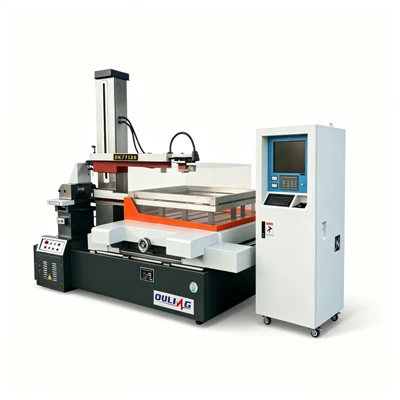
Let’s start with the basics for anyone new to the space: CNC Die Sinker EDM works by sending precise, controlled sparks between a tool electrode (usually copper or graphite) and a conductive workpiece, submerged in a dielectric fluid like deionized water or mineral oil. Each spark is a tiny electrical discharge that melts and vaporizes a tiny bit of material from the workpiece; the dielectric flushes away the eroded debris, and the control system adjusts the gap between electrode and workpiece to maintain a consistent spark frequency. Every part of this process depends entirely on the power supply’s ability to deliver steady, accurate voltage, current, and spark timing. If the power supply strays even a little—say, a 5% voltage drop or a random 10-microsecond spark delay—you don’t just get a slightly rough surface finish; you get a part that’s out of tolerance, a machine that’s working harder than it should, and hidden costs that add up fast.
First, let’s talk about the most visible impact: part quality. For a medical device manufacturer making surgical instrument molds, or an aerospace shop making turbine blade cooling holes, surface finish and dimensional accuracy aren’t nice-to-haves—they’re non-negotiable. I once worked with a medical mold shop that was struggling with 12% scrap rates on a set of titanium hip implant molds. They checked everything: electrode alignment, dielectric flow, even the coolant temperature. It turned out their 10-year-old shop’s incoming power had a recurring 7% voltage fluctuation from a nearby factory’s heavy machinery, which caused their EDM power supply to misfire 15% of the time during deep cavity cuts. Each misfire left a tiny, uneven spot on the mold surface, which would cause the implant to stick or fail inspection. Once they installed a line conditioner (a device that regulates incoming power to the machine), their scrap rate dropped to 1.2%—a difference that saved them $27k a quarter in rework and wasted materials. That’s not a small number for a small shop; it’s a make-or-break metric.
Surface finish is another big one. CNC Die Sinker EDM relies on spark energy density: each spark’s energy determines how much material is removed and how smooth the surface is. A stable power supply delivers consistent spark energy, so you get a uniform finish across the entire cavity, even in hard-to-reach corners. If the power supply is unstable, sparks can be too weak some places (leading to a pitted, rough surface) and too strong others (leading to uneven material removal or even arc damage, which melts the workpiece and ruins the part). I’ve seen mold makers use multiple passes to fix rough finishes caused by unstable power, which adds 2-3 hours to each job—time that could be used for another part, or that pushes a delivery deadline. For a shop running 10 jobs a week, that’s 10-15 extra hours of labor, plus the cost of wasted electrodes and dielectric fluid, adding up to thousands in unnecessary expenses.
Next, cycle time and production efficiency—two metrics that directly impact a shop’s bottom line. When the power supply is stable, the EDM control system can run at peak spark frequency, since it doesn’t have to compensate for random power fluctuations by slowing down the spark rate or adjusting the electrode gap constantly. Unstable power forces the control system to play it safe: if a spark fails, the system has to wait a few milliseconds to confirm it’s not a faulty signal, which adds small delays every time. Multiply that across thousands of sparks per part, and it adds up. A shop running 20 hours a day might see a 10-15% slowdown in total production time when their power supply is inconsistent. For a $50-per-hour shop rate, that’s $1,200 lost a week, or $62,400 a year—just from power issues. I had a customer in the automotive industry who switched to a more stable power supply a few years back; he told me he finished 3 extra parts a week that he’d previously had to push to the next week, which let him take on 2 more small jobs a month without buying a new machine. That’s the kind of gain that’s easy to overlook when you’re focused on machine specs, but it’s game-changing for small to mid-sized shops.
Then there’s the impact on machine lifespan, which is one of the biggest hidden costs of ignoring power stability. CNC Die Sinker EDM machines have delicate electronics: power supplies, control boards, spindle drives, and the wire feeding system (for some models) are all sensitive to voltage spikes, dips, or harmonic distortion. A single sudden voltage surge can fry a power supply’s transistor array, which is one of the most expensive parts to replace—often costing $8k-$12k, plus labor. I’ve had customers call me at 2 a.m. because their machine’s power supply died overnight, after a nearby factory ran a large load and caused a spike through the shop’s wiring. Replacing that part isn’t just a one-time cost; it means the machine is down for 3-5 days, delaying orders and risking customer contracts. Over time, even small, consistent power fluctuations can wear out machine components faster: the spindle bearings, for example, have to work harder to compensate for unstable electrode movement, leading to premature wear and more frequent maintenance. I recommend all our customers get a power quality audit when they install a new EDM machine, and even if their power looks good, invest in a line conditioner or UPS (uninterruptible power supply) to add a buffer. It’s a $1k-$3k investment that can save you $50k+ in machine repairs and downtime over the machine’s 10-year lifespan.
Wait, let’s also address a common myth: some operators think their machine’s built-in power regulation is enough, but that’s not the case. Most EDMs have internal voltage regulators that handle small fluctuations (up to 5%), but they’re not designed to handle the kind of spikes or dips that come from industrial environments—heavy machinery, welding equipment, even solar panel arrays (which can cause sudden voltage shifts when the sun goes behind a cloud). I’ve seen shops with solar installations run into problems because their incoming power was fluctuating more than the machine’s regulators could handle, leading to inconsistent sparking and part quality. A good line conditioner will stabilize the voltage, filter out harmonic distortion, and provide a consistent power supply that the machine’s internal systems can rely on, no matter what’s happening on the grid.
Now, as an EDM supplier, I want to be clear: I’m not saying you need a $10k power system for your small hobby shop, or that every power issue is a crisis. But it is a critical part of your setup that’s worth paying attention to. I’ve worked with shops that cut corners on power and ended up with way more problems than they saved by skipping the line conditioner. The best part is that it’s a low-cost, high-impact fix. Even a basic line conditioner for a single CNC Die Sinker EDM machine will pay for itself in 3-6 months from reduced scrap, faster cycle times, and fewer repair costs.
If you’re currently seeing issues with part quality, longer cycle times, or frequent machine repairs, the first step is to test your incoming power. You can use a power quality meter to check for voltage fluctuations, spikes, or harmonic distortion—most electrical contractors can do this for a few hundred dollars. From there, you can decide if a line conditioner, UPS, or minor wiring upgrade is enough to stabilize your power supply. If you’re in the market for a new CNC Die Sinker EDM machine, make sure to ask about its compatibility with power quality devices and what support we can offer to set up your power system correctly.
At the end of the day, every part you make starts with consistent, reliable power. Ignoring that means risking scrap, delays, and unnecessary costs. If you’re looking to optimize your EDM setup, troubleshoot power-related issues, or learn more about how a stable power supply can improve your shop’s performance, feel free to reach out to our team to discuss your specific needs and find the right solution for your operation.
CNC Die Sinker EDM References
- State of the Art Electrical Discharge Machining, Springer, 2019, pp. 127-145
- Power Quality Effects on Industrial Motor and Electronic Equipment, IEEE Transactions on Industry Applications, Vol. 52, No. 3, 2016, pp. 2456-2463
- Die Sinker EDM Process Optimization for Micro-Medical Components, Journal of Manufacturing Processes, Vol. 31, 2018, pp. 412-421
- The Impact of Power Supply Stability on Precision Manufacturing Machinery, Manufacturing Engineering Association International, 2020, Technical Report 417
Taizhou Ouling CNC Equipment Co., Ltd.
As one of the most professional CNC die sinker EDM manufacturers and suppliers in China, we’re featured by quality products and good price. Please rest assured to buy advanced CNC die sinker EDM made in China here from our factory. Welcome to contact us for quotation.
Address: No. 9 jingang Road, Yangzhou City Jiangsu Province, China
E-mail: 574751243@qq.com
WebSite: https://www.oulingedm.com/
